



On the path to inner awakening, balancing the third eye chakra begins with precise localization, identifiable signs of imbalance, and then concrete practices: meditation, lithotherapy, yoga, nutrition—each rooted in Himalayan tradition. Every step thus offers a tangible tool, simple to integrate and fully evolving.
Understanding the Third Eye Chakra and its Role
Located between the eyebrows, the sixth chakra, called ajna chakra or frontal chakra, governs subtle perception, clairvoyance, and intuition. Indigo-hued, element of light: everything about it recalls mental clarity. Tibetan tradition teaches that this energy bridge connects the sensory world to refined planes of consciousness. Unlike superficial approaches, harmonizing this center requires the stability of lower chakras followed by gradual opening.
As the mantra Om rings out, the vibration enters the ajna. One then feels a physical echo in the pineal gland, which is the subtle regulator of biological rhythms.
To support this sonic grounding, the dedicated singing bowl diffuses a pure wave that targets the frontal center directly. In addition to seated practice, the cuivre 7 chakras necklace bears a piece of lapis-lazuli: the mineral vibration supports mental clarity through the metal's conductivity. Once grounded, the Sacred Alignment bracelet reminds the wrist of inner vigilance throughout the day.
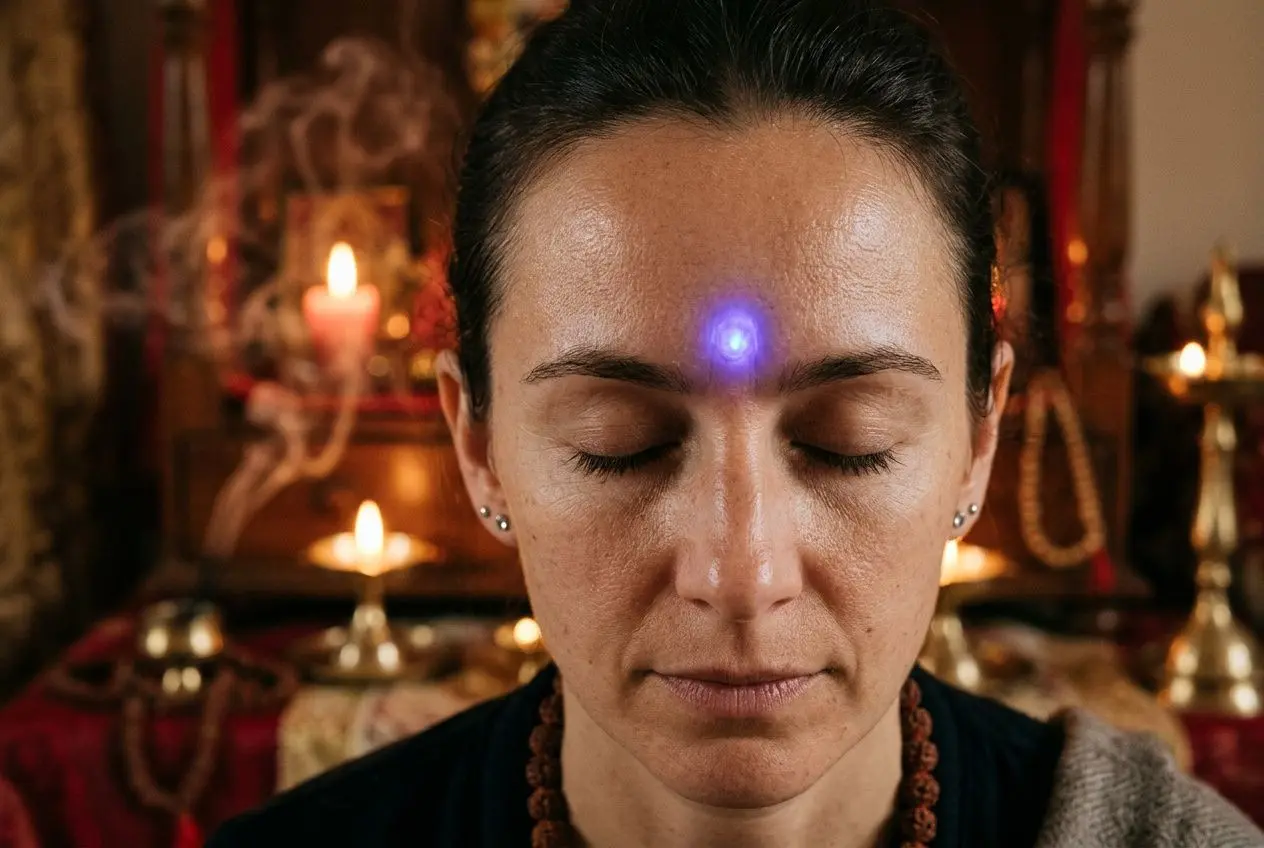
Location and Symbolism of the Ajna Chakra
The dense indigo of the frontal chakra is imprinted on the middle of the forehead. An inverted triangle, a stylized eye: this ancient symbol evokes the ability to perceive reality behind the veil of appearances. In meditation practice, visualize a gentle clarity in the center of your head to calm the stream of thoughts.
Energetic Functions and Link to the Pineal Gland
The third eye chakra orchestrates discernment, creative visualization, and dream memory. Its biological reflection, the pineal gland, synchronizes sleep and wakefulness. Balance is built when deep breathing nourishes this subtle-physical duo. Establish a calm breath, then let the silent chanting of the mantra stabilize your concentration.
Signs of a Balanced Third Eye
A balanced third eye manifests through tangible signs in daily life.
- Reliable intuition: inner impulses coincide with factual reality.
- Lucid dreams: the nighttime scenario transforms into an active learning space.
- Mental clarity: thoughts settle and tensions calm on their own.
- Fluid creativity: inner visions guide towards peaceful decisions.
Noting these markers in a journal allows you to measure evolution: frequency of lucid dreams, constancy of intuition, quality of sleep. Over time, a balanced sixth chakra establishes lasting discernment, perceptible even in the quality of daily decisions.
Symptoms of an Imbalanced or Blocked Ajna Chakra
When the sixth chakra fluctuates, two deviations appear: blockage or overactivation. Each leaves a different seal on the body and mind. Recognizing these signs paves the way for conscious readjustment: proceed slowly, with steady breath.
Signs of a Blocked Third Eye Chakra
A blocked third eye chakra traps thought. Prolonged confusion, fixed ideas, and unfounded fears follow one after another. On a physical level, migraines, pressure between the eyebrows, persistent insomnia, and mental lassitude indicate that Ajna is curling up. Memory fades, dreams fall silent (blocked eye, mute intuition, mind without a compass); in meditation practice, first bring attention back to breathing.
Risks of an Overly Open Third Eye
Unlike superficial approaches, Tibetan tradition teaches that excessive opening becomes rootless. A third eye open without a solid foundation in the lower chakras leads to illusions, distorted visions, and unstable mood. Egocentrism and insecurity feed each other, signaling chakra imbalance due to overactivation. Once anchored in the root, sacral, and solar plexus chakras, Ajna finds its proper place.
Regardless of the deviation—blocked or overstimulated—Ajna requires the same discipline: meditation, mantra, or mudra practiced with constancy, not haste. Choose this gentle path and adhere to it for a sustained period. On the path to wisdom, true rhythm remains that of the breath.
Meditation and Sounds for Activating the Third Eye Chakra
In Tibetan tradition, the journey leads step by step toward balance. Once breathing is anchored in the lower chakras, work on the third eye chakra can begin. The activation of this energy center is experienced like a gradual ascent, far from any haste.
Meditation and Visualization Techniques for Ajna
A stable sitting posture, back straight, allows you to turn your inner gaze toward the point between the eyebrows. A few deep breaths are enough to calm the mind. As calm settles, a soft indigo light enters: welcome its presence with every inhale. Five to ten minutes is sufficient; beyond that, the mind tends to wander and the grounding is lost.
- Alternate Nostril Breathing (Nadi Shodhana): this exercise balances the two cerebral hemispheres to open the way to subtle meditation.
- Indigo Light: visualizing a glowing sphere vibrating between the eyebrows helps to densify energy at the center of the skull.
- Mantra Om: reciting this sacred sound, aloud or internally, harmonizes Ajna's vibration.
- 852 Hz Frequency: listening to this sound vibration supports the process, particularly when Tibetan singing bowls accompany meditation.
Next, note your impressions, colors, and images in a journal; the recurrence of certain symbols signals Ajna's progress. This writing ritual fixes subtle perceptions before they fade.
The Tibetan Singing Bowl for Stimulating Intuition
The bronze or brass singing bowl naturally resonates with the sixth chakra. Lying down, place it near your forehead and slowly run the mallet over it: the vibration passes through the skull, dispelling tension and clarifying inner vision. A ten-minute session is enough to feel the mental space expanding.
Just as each stone acts on a specific frequency, each bowl maintains a particular rapport with a chakra: that of bronze or brass naturally tunes to the sixth. A velvet cushion stabilizes the instrument while a silent space amplifies the purity of the resonance. Be sure to maintain a steady movement to preserve the clarity of the sound.
Affirmations, Mantras, and Dream Journaling
Himalayan wisdom reminds us that words spoken with attention sculpt consciousness. Chant these formulas holding the mind between your eyebrows:
- I trust my intuition.
- I see my path clearly.
- My third eye opens safely.
- The dream journal: the morning recording of night images and symbols highlights Ajna's subtle activity.
Add five minutes of silent observation upon waking to contemplate the passing thoughts and emotions without judgment. A short practice repeated every morning is more effective than a long, occasional session.
Lithotherapy and Crystals for Balancing the Third Eye
Tibetan tradition teaches that deep blue, indigo, and violet vibrate in unison with the ajna chakra. As soon as you place lapis lazuli or amethyst on your forehead, the stone becomes a tangible reminder: harmony is established when breathing calms and attention focuses between the eyebrows. The mineral does not replace meditation; it supports inner drive.
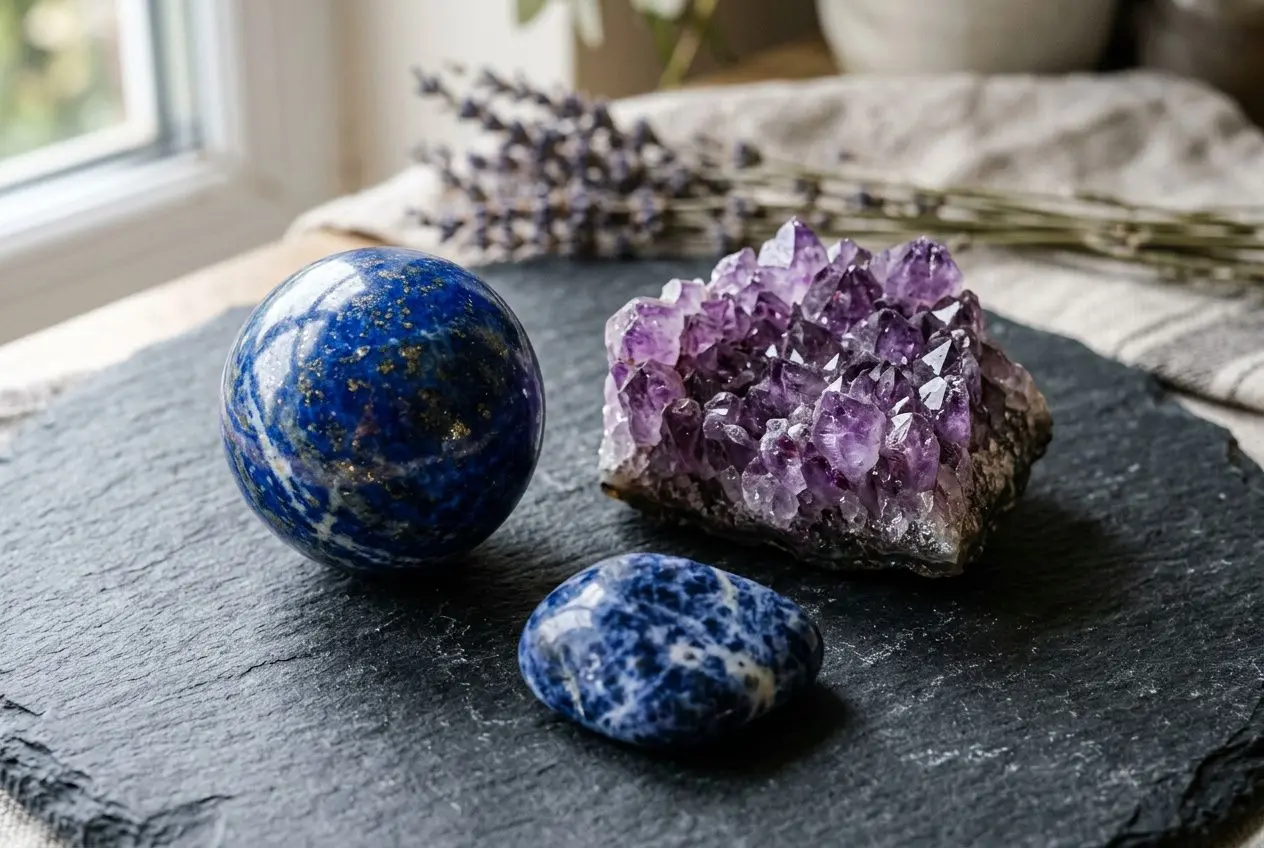
Key Stones for the Ajna Chakra
Three stones stand out to accompany the Ajna chakra. Lapis lazuli illuminates clairvoyance and dispels mental fog: sodalite gently clarifies emotions, while amethyst invites inner silence and soothes a blocked or overly stimulated chakra. Choose according to the current state and keep the stone near you for at least twenty-one days to allow the vibration to settle.
In addition to these classics, labradorite protects the space of intuition, azurite dynamizes subtle perception, and hawk's eye fluidifies inner vision. Place these crystals on your meditation altar to raise the vibration of the place.
| Stone | Color | Primary Action | Recommended Use |
|---|---|---|---|
| Lapis lazuli | Indigo blue | Clairvoyance, truth, self-knowledge | Necklace, forehead meditation |
| Sodalite | Dark blue | Mental clarity, intuition, wisdom | Bracelet, pocket |
| Amethyst | Violet | Serenity, spiritual connection, peace | Meditation, purification druse |
| Labradorite | Iridescent gray | Protection, subtle vision, transformation | Pendant, meditation |
| Azurite | Deep blue | Intuitive activation, expanded consciousness | Placement on the forehead |
Jewelry and Energetic Accessories for Ajna
The copper seven-chakra necklace connects lapis lazuli to other centers: the metal, a traditional conductor, fluidifies energy from the base to the crown. Hold the necklace between your palms while gently inhaling to visualize a white ray passing through every bead.
The Sacred Alignment bracelet marries sodalite and quartz crystal: each stone acts on the fluidity of subtle currents. Wear this ornament during the day before purifying it with Tibetan incense or white sage. Once grounded, recharging it under the moonlight or on a bed of quartz preserves intuition indefinitely.
Yoga, Nutrition, and Lifestyle for Harmonizing Ajna
On the path to third eye balance, action first passes through the body. Yoga, plate, and daily gestures weave together a subtle thread: they support the harmonization of the third eye chakra without ever forcing it.
Yoga Poses to Activate the Third Eye
Third eye yoga directs energy towards the sixth chakra while securing inner foundations. Balasana opens the series: forehead on the ground, spine stretched, five slow breaths. The frontal contact awakens Ajna and simultaneously relaxes the nervous system.
Once grounded, inversions amplify the energetic flow. Halasana, Uttanasana, or Sirsasana create this ascent. Padmasana then stabilizes the surge of impetus for deep meditation. The alternation between effort and release reflects chakra balance: expansion, followed by rest.
- Balasana: five breaths, forehead anchored, gentle activation of the third eye.
- Halasana: legs beyond the head, conscious holding, direct stimulation of Ajna.
- Inversions: Setu Bandhasana, Uttanasana, Sirsasana, each for five breaths for a balanced sixth chakra.
In meditation practice, Makarasana concludes the sequence: the pose releases the lumbar area and places the practitioner in silence before sitting.
Nutrition Favorable to the Pineal Gland
Prioritize dark-colored foods: blueberries, dark grapes, eggplant, or red cabbage vibrate at the frequency of the third eye. A touch of raw cocoa elevates mood and supports inner work.
Tibetan tradition teaches that nutrient purity sustains subtle breath. Omega-3s from nuts and chia seeds strengthen mental clarity and nourish the frontal chakra. Unlike superficial approaches, reducing refined sugars and night lighting prevents confusing melatonin and refines dream perception.
Essential Oils and Lifestyle for Ajna
Incense, sandalwood, lavender, or jasmine essences accompany Ajna's activation. Apply a diluted drop between the eyebrows before the session: this simple act establishes the vibrational field of the third eye chakra. When diffused in the room, they prolong concentration without tension.
Balance is built when sleep remains regular. Devote seven to eight hours to rest under dim lighting, and note your visions in a dream journal upon waking: these habits sharpen subtle memory. Five minutes of silent observation every morning, screen-free, consolidate the balance of the Ajna chakra day by day.
Frequently Asked Questions
How do I balance my third eye chakra daily?
The key to balancing the third eye chakra lies in a regular rhythm, never in haste. As seated posture becomes natural, devote ten minutes to silent meditation: inhalation followed by exhalation allows you to imagine an indigo mist condensing between the eyebrows, thereby nourishing the activation of the third eye without forcing passage. In addition to this inner work, wearing a lapis-lazuli mala or listening to a singing bowl emitting two or three harmonics before sleep supports internal clarity through external vibration. Tibetan tradition teaches that consistency is better than a long isolated retreat.
What are the symptoms of a blocked third eye chakra?
Pay close attention to physical signs: a blocked third eye chakra, called ajna in Sanskrit lineage, manifests as persistent headaches or eyebrow pulling. Mentally, this state leads to confused thoughts and lack of intuition. Tradition also invites recognizing dream poverty: rare or faded dreams upon waking often signal a blocked third eye. Once anchored in the base chakras, one balances ajna: circulating energy restores inner clarity, forehead pressure lightens, and a sense of progressive unity returns over time.
Is it dangerous to activate the third eye too quickly?
Haste in opening the third eye exposes you to dissociation, mood swings, and perceptual mirages. In meditation practice, begin by strengthening root, sacral, and solar plexus: this base retains energy when the activation of the third eye intensifies. Once this axis is stable, Ajna's harmony unfolds serenely through frontal yoga postures, the OM mantra, and indigo stones. Mineral influence supports this subtle resonance: a sodalite placed under the pillow soothes if the blocked chakra gives way too abruptly.